
In today’s digital marketing landscape, driving traffic to your website is only half the battle. The real challenge lies in turning those visitors into paying customers. This is where Conversion Rate Optimization (CRO) comes into play.
CRO is the art and science of improving your website’s ability to convert visitors into customers, subscribers, or leads. It’s not about getting more traffic; it’s about getting more value from the traffic you already have. Whether you’re running an e-commerce store, a SaaS company, or a lead generation site, optimizing your conversion rate can significantly boost your business’s profitability.
In this article, we’ll explore the core principles of CRO, share key strategies for implementation, and discuss how to measure success. If you’re looking to increase your sales, grow your email list, or improve any other conversion goal, read on.
What is Conversion Rate Optimization (CRO)?
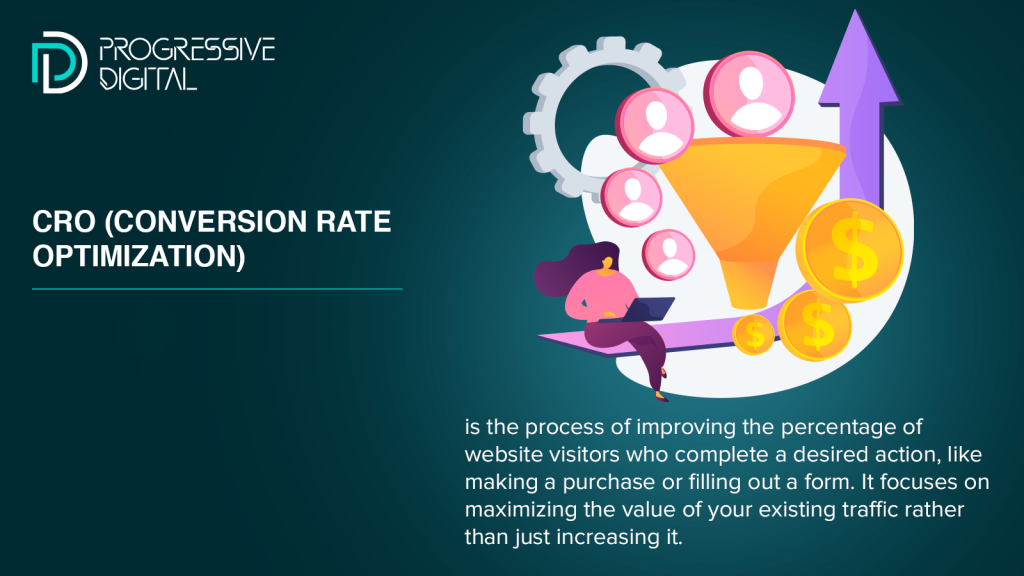
CRO is a systematic process aimed at improving the percentage of website visitors who complete a desired action. This action could be anything from making a purchase, filling out a contact form, subscribing to a newsletter, or signing up for a free trial. Simply put, it’s about making your website work harder and smarter to turn passive visitors into active customers.
To measure CRO, you need to track key performance indicators (KPIs) that align with your business objectives. The most common metric is the conversion rate itself, which is calculated by dividing the number of successful conversions by the total number of visitors and multiplying by 100. For example, if 100 visitors come to your site, and 5 of them make a purchase, your conversion rate would be 5%.
Why is CRO So Important?
- Maximizes Existing Traffic
CRO makes the most of your existing traffic. Every website has visitors, but many don’t take the desired action. By improving your website’s conversion rate, you can increase revenue without having to spend extra money on driving more traffic. - Lower Customer Acquisition Costs
Increasing your conversion rate means that you’re getting more customers for the same amount of traffic. This naturally lowers your customer acquisition cost (CAC), as your marketing spend is more effectively converted into paying customers. - Improved User Experience (UX)
A good CRO strategy often leads to a better user experience. It involves optimizing website design, streamlining navigation, and making it easier for users to take action. This, in turn, builds trust, which can help boost both conversions and customer loyalty. - Better ROI
If your website is optimized to convert better, you’ll see a higher return on investment (ROI) from your marketing campaigns. A small increase in your conversion rate can make a significant impact on your bottom line.
Key Strategies for CRO
CRO is not a one-size-fits-all solution; it involves testing, learning, and tweaking. Here are some of the most effective strategies you can implement to optimize your website for conversions:
1. Make Your Value Proposition Clear
A value proposition is the promise of value you will deliver to your customers. It’s what sets you apart from your competitors and convinces visitors that they should choose you over others. If your value proposition is unclear or buried in text, your visitors won’t know why they should stay.
- Simplify Messaging: Your value proposition should be easy to understand and immediately visible on your homepage and landing pages.
- Use a Clear Call-to-Action (CTA): After explaining your value, direct visitors to take action with a bold, clear CTA. Make it prominent on your page and ensure it’s repeated throughout.
2. A/B Testing: The Power of Experimentation
A/B testing, or split testing, is one of the most powerful tools in a CRO specialist’s arsenal. It involves creating two versions of a webpage (version A and version B) with one key difference, such as a headline, color scheme, CTA button, or layout, to see which performs better.
- Focus on High-Impact Pages: Start with pages that drive the most traffic and conversions, such as your homepage, product pages, or checkout pages.
- Test One Element at a Time: To get accurate results, test only one element at a time (e.g., headline, CTA button color, form length).
- Use Statistical Significance: Ensure you have enough traffic to your A/B tests to reach statistical significance so that you can make informed decisions.
3. Improve Website Load Speed
Visitors won’t wait around for slow-loading websites. According to Google, 53% of mobile users abandon a site if it takes longer than 3 seconds to load. Slow page load times can negatively impact both your bounce rate and your conversion rate.
- Optimize Images: Large image files are a common culprit. Use compressed image formats like WebP, or ensure images are appropriately sized for faster loading.
- Use a Content Delivery Network (CDN): A CDN helps reduce load times by storing your website’s files across multiple servers worldwide.
- Minimize JavaScript and CSS Files: Too many large files can delay your site’s performance. Use tools like Gzip compression to reduce file sizes.
4. Make Your Forms Short and Simple
Long forms are a major deterrent for conversions. If you’re asking for too much information, visitors are likely to abandon your site before completing the form. Instead, keep your forms short, asking only for essential details.
- Use Multi-Step Forms: Break longer forms into smaller, manageable steps. This approach can feel less overwhelming and increase completion rates.
- Use Inline Validation: Provide real-time feedback on form fields, helping users identify mistakes before submitting.
- Offer Social Sign-Up Options: Allow users to sign up via their social media accounts (e.g., Google or Facebook) to speed up the process.
5. Optimize Your Checkout Process
For e-commerce websites, the checkout process is crucial. A complicated or lengthy checkout process can lead to cart abandonment. Streamlining your checkout process is essential for maximizing conversions.
- Offer Guest Checkout: Not all visitors want to create an account. Allow them to make purchases without signing up.
- Provide Multiple Payment Options: Offer various payment methods, including credit cards, PayPal, Apple Pay, and even installment plans.
- Use Progress Indicators: Show users how many steps are left in the checkout process so they know how close they are to completing their order.
6. Mobile Optimization is a Must
In today’s mobile-first world, having a mobile-optimized website is no longer optional. A significant portion of traffic now comes from mobile devices, so it’s crucial to ensure that your site is responsive and user-friendly on all screen sizes.
- Use Mobile-First Design: Prioritize designing for mobile devices first, ensuring your site is easy to navigate and use on smartphones.
- Test for Mobile Usability: Regularly test your website on mobile devices to ensure all buttons, forms, and CTAs work seamlessly.
7. Leverage Social Proof
Social proof is the psychological phenomenon where people tend to follow the actions of others. By showcasing positive reviews, testimonials, or case studies, you can build trust with potential customers and persuade them to convert.
- Customer Reviews and Testimonials: Display customer reviews and testimonials on your product pages or checkout process to add credibility.
- Case Studies: Share detailed case studies that showcase how your product or service has benefited other customers.
- Social Media Mentions: Highlight any notable social media mentions, such as user-generated content or influencer endorsements.
8. Implement Live Chat or Chatbots
Offering immediate assistance can be a game-changer for your conversion rate. Live chat or chatbots can answer questions, resolve issues, and even help guide visitors through their purchasing journey in real-time.
- Provide Instant Support: Use live chat to help visitors who may be hesitant or have specific questions about your product.
- Use Chatbots for Common Queries: For less complex questions, use AI-powered chatbots to provide instant answers without human intervention.
Measuring Success: Key Metrics for CRO
To know whether your CRO efforts are paying off, you need to track the right metrics. Here are a few important KPIs to monitor:
- Conversion Rate: The percentage of visitors who complete a desired action on your website (purchases, sign-ups, etc.).
- Bounce Rate: The percentage of visitors who leave your site after viewing only one page. A high bounce rate can indicate a need for improved content or design.
- Average Order Value (AOV): For e-commerce sites, AOV measures the average value of an order and can be a good indicator of your CRO efforts.
- Cart Abandonment Rate: For e-commerce businesses, this metric tracks the percentage of users who add items to their cart but don’t complete the purchase.
- Time on Site: The longer users stay on your website, the more likely they are to convert. Track how long visitors stay and which pages they engage with.
Conclusion: CRO is an Ongoing Process
CRO is not a one-time fix; it’s an ongoing process of testing, analyzing, and optimizing. By continually refining your website, analyzing user behavior, and making data-driven adjustments, you can increase your conversion rate over time and see a significant impact on your bottom line.
Implementing the strategies we’ve discussed—from improving your value proposition and A/B testing to optimizing for mobile and using social proof—will ensure that your website is not just attracting visitors, but turning them into loyal, paying customers.
So, if you’re ready to see an increase in your conversions, it’s time to start optimizing. Your website traffic is valuable—let’s make it work harder for you.