
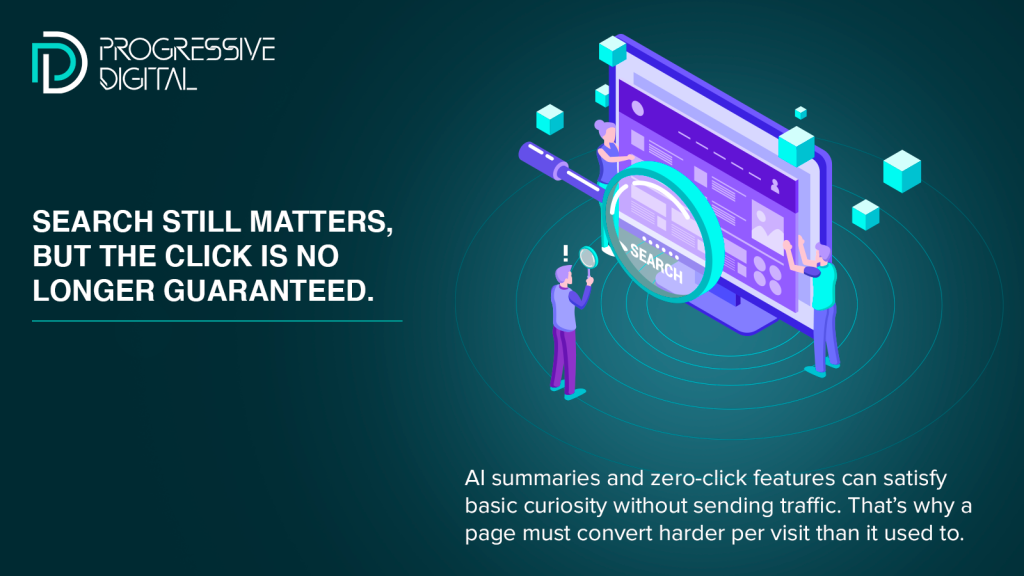
SEO used to be simple to explain. You publish a page, you rank, you get clicks, and you turn those clicks into leads. That story still happens, but it is no longer the default. More often now, the search results page is the experience. People read an AI summary, skim a featured snippet, glance at two titles, and make a decision with fewer clicks than ever.
This is where a lot of businesses get stuck. They see visibility in Search Console, they see impressions climbing, and they assume the pipeline will follow. Then reality shows up. The traffic is flatter than expected, the conversions are inconsistent, and the team starts debating if SEO still works. It does. The rules simply changed. The winner is no longer the page that only answers the question. The winner is the page that makes the reader trust you enough to take the next step even after they have already gotten a quick answer elsewhere.
What People Actually Do After Reading an AI Summary
Most searchers do not stop because they are fully satisfied. They stop because they feel informed enough to choose. This is a crucial difference. They may not know everything, but they know enough to decide who seems credible.
That means your page is competing on two stages. Stage one is being understood and pulled into summaries. Stage two is being chosen when someone is evaluating options. Traditional SEO focused heavily on stage one. Modern SEO must perform on both, because a smaller number of visits now carries a bigger responsibility. Every click must count more.
Write for Extraction and for Humans at the Same Time
A painful mistake in this era is making your most generic sentences the easiest to quote. AI systems love clean, short lines. If the cleanest lines on your page are empty claims, those empty claims become your public face.
Instead, build quote friendly sentences that carry meaning. These are the lines that a reader could screenshot and send to a coworker. They also happen to be the lines AI summaries tend to reuse.
Examples of strong quote friendly lines look like this
A good SEO page does not just answer a question, it removes a doubt
If your message is unclear above the fold, traffic will not save you
Ranking brings attention, but structure creates decisions
Notice how these are short and simple, but not vague. They communicate a point of view. They sound like a human who has seen the same problem many times.
A Page That Converts Reads Like a Decision Path
Most SEO articles are written like school assignments. They begin with a broad introduction, then define terms, then slowly wander toward the point. That format does not match how people decide. It especially fails when attention is shorter and the summary already handled the basics.
A high converting SEO page has rhythm. It moves the reader from curiosity to clarity, and from clarity to action. The easiest way to get this right is to build a decision path.
A decision path usually includes
The real situation the reader is in
The quick answer in plain language
The important details that change the outcome
A comparison moment that helps them choose
Proof that feels specific and grounded
A next step that feels helpful and low pressure
This is not about being salesy. It is about being useful in a way that reduces uncertainty. People do not convert when they are impressed. They convert when they feel safe choosing.
Make Your First Screen Do More Work
In the past, you could afford a slower warm up. Today, the first screen of your page matters more because a reader might never scroll far. They might arrive from a summary, scan quickly, and bounce if they do not feel immediate relevance.
Your first screen should do three things
Confirm they are in the right place
Show a clear promise of what they will get
Offer a small proof point or credibility cue
That proof point can be light. A quick line about who this is for, a practical outcome you can help with, or a simple explanation of your approach. The goal is to signal competence without sounding like marketing copy.
Make Scanning Feel Easy and Safe
People scan because they are busy and skeptical. They are not being rude. They are protecting their time. Your job is to make scanning feel safe, like they will still get value even if they move quickly.
That requires clean formatting. Short paragraphs with one idea each. Subheadings that sound like real thoughts, not corporate labels. Occasional one line takeaways that reset attention.
If your subheadings could be swapped with another agency’s page and nothing changes, they are too generic. A good subheading sounds like a reader’s internal question, then your section answers it in the next few lines.

Add Choice Points That Reduce Anxiety
AI summaries are decent at information. They are weaker at judgment. They can explain what something is, but they struggle to tell someone if it is right for their situation. This is where modern SEO pages win.
A choice point is a moment where you help the reader self select. It lowers the fear of choosing wrong. It also increases trust because it feels honest and practical.
Choice points might include
Best for teams that need predictable lead flow
Not ideal if your offer changes every week
Start here if you have limited time
Do this later if your foundations are not ready yet
These moments are conversion gold because they make the reader feel understood. They also make your content shareable. People love sending choice points to a partner because it feels like clarity without friction.
Put Proof Early and Keep It Specific
A common habit is to hide proof near the bottom. Teams think they need to educate first, then sell. But in the new SEO environment, you may not get enough attention to earn that slow build.
Bring proof forward. Keep it relevant to the page’s intent. Proof does not need to be a loud case study. It can be a mini story that shows you know what changes outcomes.
A strong mini proof often includes
The starting problem
The key fix
The change that followed
For example, instead of saying you improved performance, explain that you rewrote the first screen to match intent, added a comparison section to reduce confusion, and placed a micro CTA after a checklist. That sounds real because it is a method, not a claim.
Build Micro CTAs Into the Reading Experience
If you only ask for action at the end, you are speaking to the smallest group of visitors. Modern pages convert better when they include micro CTAs in natural pause points.
A natural pause point happens when the reader feels relief or recognition. It might be right after you explain a mistake that costs money. It might be right after a checklist. It might be after a comparison section that makes the choice clearer.
A micro CTA is calm. It can be as simple as inviting them to get a quick audit, request an example, or ask a question. The tone matters. It should feel like help, not pressure.

The Three Layer Model That Makes SEO Work Again
If you want one simple model to build around, think in three layers.
Information
Evaluation
Decision
Information answers the question. AI summaries do this fairly well. Evaluation helps the reader compare options and avoid mistakes. Decision makes the next step obvious and low friction. This is where human trust lives.
When your page delivers all three layers, AI summaries stop being a threat. They become a pre qualifier. The reader who clicks arrives with higher intent, and your page is built to convert that intent because it does not only inform. It guides.